
Trace for macOS
Ask the literature.
Get a brief you can defend.
Ask a hematology question the way you’d actually say it. Trace reads the primary literature and returns a sourced brief — every sentence linked to the exact paper, every number to a verbatim quote you can hover and read. Sources only; it never invents.
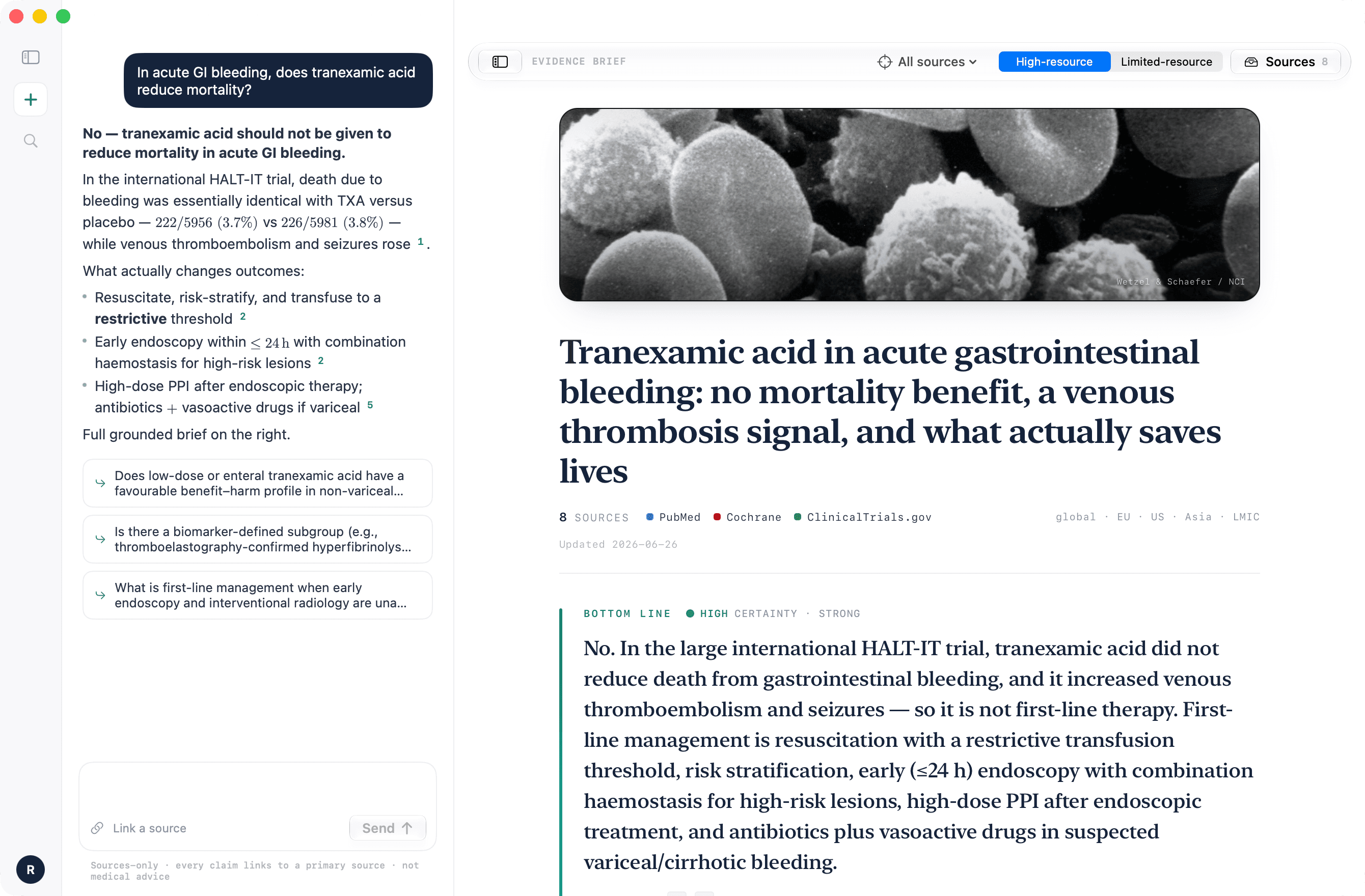


The relative risk of death from bleeding was 0.99.1
A number you could act on — so you should be able to see exactly where it came from.
Verbatim, not paraphrased — every quote re-checked against the source text.
A claim it can’t ground is removed, not guessed.
Open the paper in one click.
We didn’t build a smarter search box. We built the brief you’d want to defend.
Pick a sentence. See the source.
The same gesture, anywhere in hematology — a claim, then the exact paper sentence behind it. Four examples, four source types.
Tranexamic acid did not reduce mortality in acute gastrointestinal bleeding.1
We found that tranexamic acid did not reduce death from gastrointestinal bleeding.
Cytokine release syndrome must include fever at onset and may progress to hypotension and hypoxia.2
Symptoms can be progressive, must include fever at the onset and may include hypotension, capillary leak (hypoxia) and end organ dysfunction.
Corticosteroids are recommended over observation for newly diagnosed adults with ITP and platelets below 30×10⁹/L.3
In adults with newly diagnosed ITP and a platelet count of <30 × 10⁹/L who are asymptomatic or have minor mucocutaneous bleeding, the American Society of Hematology (ASH) guideline panel suggests corticosteroids rather than management with observation.
Hydroxyurea reduced the annual rate of painful crises in adults with sickle cell anemia.4
The 152 patients assigned to hydroxyurea treatment had lower annual rates of crises than the 147 patients given placebo (median, 2.5 vs. 4.5 crises per year, P<0.001).
Four sentences. Four receipts. Multiply that by a whole brief.
It only knows
what it can cite.
No web guessing. No training-memory hunches. If the literature doesn’t answer, it says so — and shows you the gap instead of filling it with a guess.





- Whether any GI-bleed subgroup benefits from early TXA remains unresolved.
- Optimal timing of tocilizumab vs corticosteroids in grade-2 CRS is debated.
We’d rather show you the gap than fill it with a guess.
The same question has a different answer in a different hospital.
Endoscopic haemostasis within 24 hours with proton-pump-inhibitor infusion; transfuse to a restrictive haemoglobin threshold of 7 g/dL.2
A US-centric tool gives one answer. Trace marks resource tiers — and tells you plainly when the evidence was generated somewhere your patient doesn’t live.
Forest plots, GRADE tables, decision trees — rendered, not just described.
Hairlines, not chartjunk. Even the figure data carries its own citation.
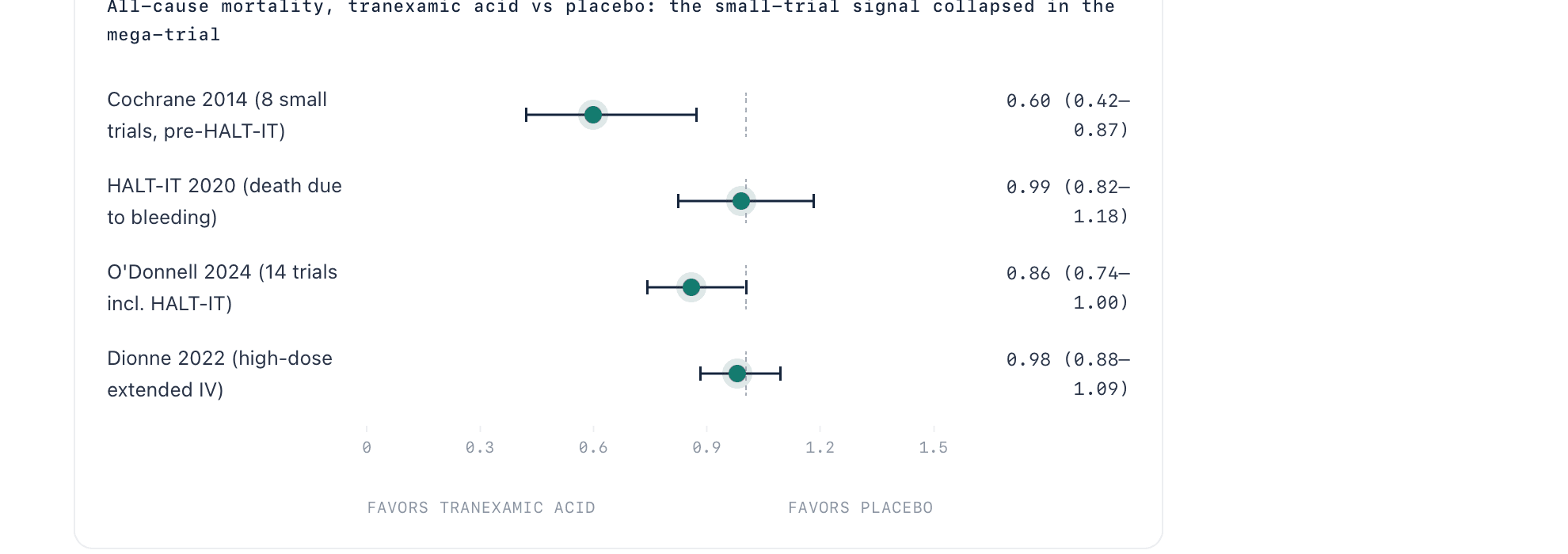
| Outcome | Effect | Certainty |
|---|---|---|
| Death from bleeding | No reduction | |
| Venous thromboembolism | Increased | |
| Rebleeding | No clear benefit |
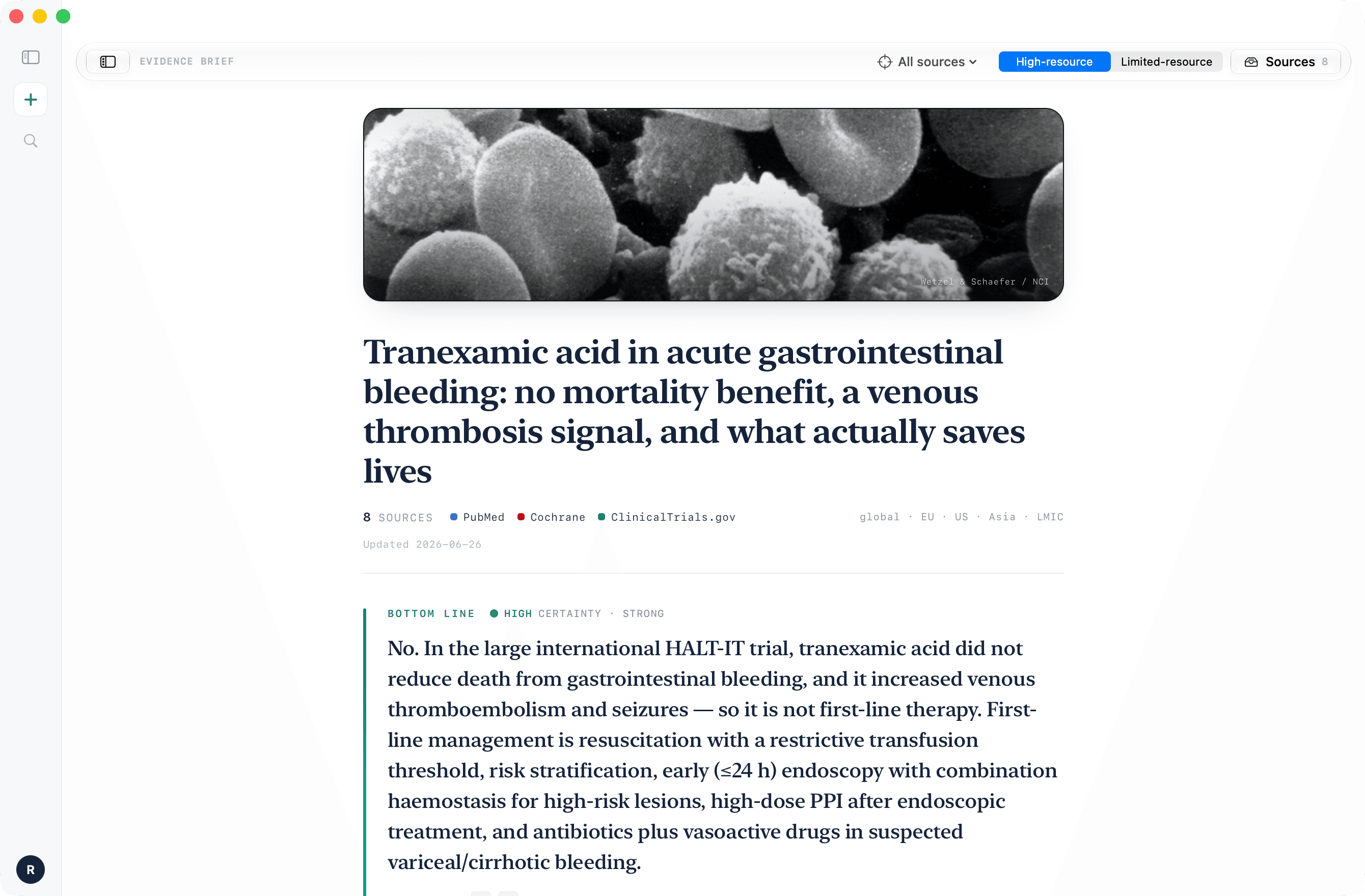
 In your Dockyet another AI tab ×
It lives in your Dock, not a browser tab.
Web tools forget you the moment you close the tab. Trace keeps your notebook.
Ask the literature.
Get a brief you can defend.
Grounded in PubMed · PMC · ClinicalTrials.gov · Cochrane · ASH · ASTCT
Every claim links to a primary source · Trace is a research aid, not medical advice.
Set in New York & SF Mono.